Neill Cream: A Daring Killer Doctor of Victorian Times

The blog is back after a two-month hiatus. I am a one-man show, and it can be challenging to produce a new blog every week. With the climax of baseball season and some other personal disruptions, I have not blogged for a couple of months. However, this week, I return with a presentation about Dr. Thomas Neill Cream. Neill Cream was a Victorian doctor, a convicted poisoner, and a man who some suspected was Jack the Ripper. Read his story below.

The Life and Crimes of Dr. Thomas Neill Cream

Neill Cream was one of the most infamous poisoners of the Victorian era. A trained physician, his medical knowledge became a weapon in a series of murders that spanned multiple continents. He died on the gallows in London in 1892, but his criminal legacy continues to fascinate criminologists and historians alike.

Dr. Thomas Neill Cream (McGill University Library)

Thomas Neill Cream was born in Glasgow, Scotland, in 1850, the eldest son of a prosperous shipbuilder. His family emigrated to Canada during his youth, settling in Quebec, where Cream grew up in relatively comfortable circumstances. In his early years, he demonstrated academic promise and eventually enrolled at McGill University in Montreal to study medicine.

While at McGill, Cream developed a fascination with chemistry and toxicology, disciplines that would later be a core component of his crimes. He graduated as a physician in 1876 after completing a thesis on chloroform. Shortly afterward, he moved to London for advanced training at St. Thomas’s Hospital before practicing medicine in North America.

Early Criminal Activity

Cream’s professional career quickly became intertwined with scandal. While practicing in Canada and later in the United States, he developed a reputation for performing illegal abortions, often under dangerous circumstances. One of his earliest brushes with the law came in 1879 when a young woman named Kate Gardener died after taking a medicine Craem prescribed. Though suspicion fell upon him, no charges were sustained.

An undated portrait of Thomas Neill Cream (Science Museum Library Collection)

Relocating to Chicago, Cream continued his medical practice but became embroiled in a more serious case. In 1881, the body of Daniel Stott, one of Cream’s patients, was discovered with traces of strychnine poisoning. Investigations revealed that Cream had supplied the fatal substance and had also been engaged in an affair with Stott’s wife. He was arrested, tried, and convicted of murder. Sentenced to life imprisonment, Cream was sent to Joliet Prison in Illinois.

Neill Cream Released

Despite the murder conviction, Cream did not serve out his life sentence. In 1891, after only ten years, he was released, reportedly through the intervention of influential family connections and perhaps bribery. Having regained his freedom, Cream left America and returned to London, settling in the Lambeth district.

London in the 1890s provided fertile ground for a man of Cream’s ambitions. The bustling city was crowded, with areas of extreme poverty and vice coexisting alongside wealth and privilege. Lambeth, in particular, was known for its red-light district, and it was here that Cream found many of his victims.

Neill Cream Resumes Poisoning in London

Soon after his arrival, young women in Lambeth began to die under mysterious circumstances. Cream consistently used strychnine, a lethal poison that was readily available at the time. The victims were often sex workers, women with little protection or recourse, making them vulnerable targets.

Among his victims were women such as Matilda Clover, who died in 1891. Initially, her death was recorded as natural, but Cream later incriminated himself by writing anonymous letters to authorities and acquaintances, claiming another physician had poisoned Clover. This peculiar tendency to boast and manipulate would ultimately contribute to his downfall.

Cream’s campaign of poisoning continued through 1891 and 1892, with other victims including Alice Marsh and Emma Shrivell. Each woman suffered an agonizing death from strychnine, and in each case, Cream attempted to deflect suspicion or even extort money by accusing others of the crimes. His pattern of sending letters and inserting himself into investigations raised suspicions about his character.

Investigation and Neill Cream Arrested

By mid-1892, authorities were piecing together evidence linking Cream to the series of poisonings. His peculiar behavior in writing letters that named himself as a witness or suggested knowledge of the murders raised questions. Detectives watched his movements closely, noting his associations with the victims and his habit of discussing poison with acquaintances.

Metropolitan Police images of Thomas Neill Cream (Science Museum Library Collection)

Ultimately, police determined that Cream had purchased strychnine shortly before several of the murders, providing material evidence against him. Witness testimony further tied him to the victims, and the case against him solidified. He was arrested in June 1892 and charged with multiple counts of murder.

Neill Cream On Trial at the Old Bailey

Cream’s trial for the murder of Matilda Clover opened at the Central Criminal Court—the Old Bailey—in October 1892. The proceedings drew enormous public attention, as the case combined sensational elements of medicine, poison, sexual scandal, and serial murder.

The prosecution presented evidence of Cream’s purchase of strychnine and his proximity to the victims before their deaths. Testimony from chemists confirmed that he had obtained the poison, while witnesses described his suspicious conversations and behavior. Particularly damning were his incriminating letters, which revealed both his knowledge of the crimes and his attempt to implicate others.

The defense attempted to argue that the evidence was circumstantial, but the cumulative weight of the case proved overwhelming. The jury deliberated only twelve minutes before finding him guilty on all counts.

Neill Cream Sentenced and Executed

Following the guilty verdict, Cream was sentenced to death by hanging. His execution was set for November 15, 1892, at Newgate Prison in London. On the morning of the hanging, crowds gathered outside the prison, as was common in high-profile cases of the era, eager to witness the outcome of one of Britain’s most notorious trials.
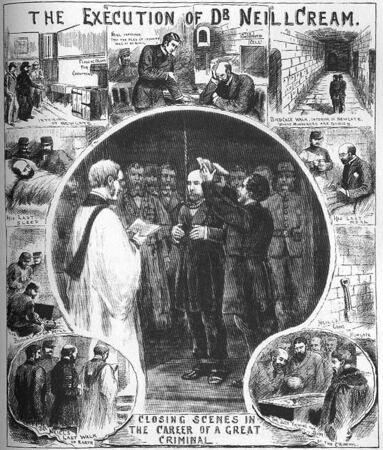
This newspaper illustration appeared about the time of Cream's execution
This newspaper illustration appeared about the time of Cream’s execution

At the gallows, Cream reportedly attempted to speak, though accounts differ on his final words. According to some reports, he began to declare “I am Jack—,” leading to speculation that he intended to claim responsibility for the crimes of Jack the Ripper. The hangman quickly pulled the lever, cutting short any further statement. Whether this was a genuine confession, a last-minute attempt at notoriety, or a misheard phrase remains debated.

Epilogue

Neill Cream’s poisonings ended with his death, but his execution did not squelch the rumors that he was Jack the Ripper. Although hangman James Billington reported Cream’s last words to be “I am Jack…,” other witnesses to the execution did not report such an event. Furthermore, Cream was incarcerated in Illinois during the Ripper’s 1888 murder spree. Theories that Cream bribed his way out of prison before his official release or that a look-alike served his sentence lack any supporting evidence.

You can read more about Neill Cream and his crimes in A Prescription for Murder, a 1995 book by Angus McLaren, and The Case of the Murderous Dr. Cream by Dean Jobb. W. Teignmouth Shore’s Trial of Thomas Neil Cream presents a detailed account of Cream’s trial.

Don’t Miss Out! Subscribe to the Newsletter

Subscribe to True Crime in the News, a monthly email newsletter that examines recent news stories of interest to true crime enthusiasts. The newsletter also summarizes the blog posts from the previous month. You won’t want to miss this. Join the newsletter mailing list today.
Denise Williams: Wife Guilty in Devastating Death of Man

It is a truism that when it comes to homicide, the perpetrator is often close to the victim. It is so often the case that detectives usually start looking for a killer “from the inside out.” This blog post is about one such case, that of Denise Williams, who was convicted of conspiring to murder her husband, Mike, for a large insurance payout.

Mike and Denise Williams

Michael “Mike” Williams was a 31-year-old real estate appraiser and a typical family man. He and his wife, Denise Williams, had been married for six years and lived in Tallahassee, Florida, with their young daughter, Anslee. As far as anyone knew, they were a devoted couple who delighted in their 18-month-old child.

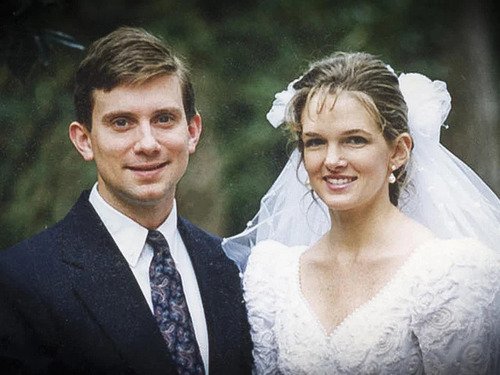
Photo from Mike and Denise Williams' wedding (Washington Post)
Photo from Mike and Denise Williams’ wedding (Washington Post)

On the cold morning of December 16, 2000, Mike set out on a routine duck‑hunting trip on Lake Seminole. Before launching his boat into the murky lake waters, he promised to be home by noon. He and Denise planned to celebrate their wedding anniversary that evening. But Mike never came home.

When Mike failed to return, his wife promptly alerted authorities. A large-scale search followed, spanning land, water, and air. It lasted for more than a month. Rescue teams found his boat adrift, his decoys and shotgun still inside, but there was no trace of Mike himself. After 44 days with no sign of his body, authorities declared him missing. Six months later, officials recovered waders, a jacket, a hunting license, and even a functioning flashlight. Authorities issued a death certificate citing an accidental drowning. Eerie rumors spread that an alligator may have eaten him.

Mike’s Mother Has Her Doubts

Local investigators leaned toward an accidental death, but Mike’s mother, Cheryl Williams, remained skeptical. She refused to accept the alligator hypothesis or accidental drowning, as such attacks are exceedingly rare, especially during the chilly winter months. Driven by her conviction, Cheryl painstakingly compiled 27 pages of observations and unanswered questions. Her dogged determination took the form of daily letters to Florida’s governor (over 1,400 in total), billboards, picket signs, and a steadfast refusal to allow the case to slip into obscurity.

Denise Merrill (later Williams), Mike Williams, and Bian Wichester as they appeared in the North Florida Christian School yearbook in 1988  (Tallahassee Democrat)
Denise Merrill (later Williams), Mike Williams, and Bian Wichester as they appeared in the North Florida Christian School yearbook in 1988 (Tallahassee Democrat)

Her advocacy paid off. Four years after the disappearance, the Florida Department of Law Enforcement initiated a full review. There was no physical evidence, no body, no witnesses, and no weapon. However, the inconsistencies Cheryl noted led authorities to turn their attention toward the few individuals who stood to benefit from Mike’s presumed death.

A Suspicious Relationship for Denise Williams

The investigation took an unexpected turn when records showed that Mike had taken out three separate life insurance policies worth approximately $1.75 million (over $3.25 million in 2025). Particularly questionable was a $1 million policy written only months before Mike’s disappearance. This policy, it turned out, had been sold by Mike’s best friend, Brian Winchester. Further thickening the plot, Brian had begun a romantic relationship with Mike’s young widow, Denise, months before Mike vanished. The couple married in 2005. These revelations raised suspicions and framed Mike’s disappearance not as an accident but potentially as a calculated homicide motivated by financial and emotional gain.

The Williams Conspiracy Unravels

For years after Mike Williams’ disappearance, law enforcement could not confront Brian or Denise directly. As long as the couple remained married, neither could be compelled to testify against the other. However, in 2016, Brian attempted to kidnap Denise at gunpoint, shifting the dynamics. Though Denise outwardly maintained her innocence, Brian’s confession in custody provided the turning point.

Mugshots of Brian Winchester and Denise Williams (Leon County Sheriff's Office)
Mugshots of Brian Winchester and Denise Williams (Leon County Sheriff’s Office)

In exchange for immunity from murder charges, Brian admitted his role in Mike’s death. He revealed that on that December morning, he and Mike had gone out on the lake under the pretense of hunting. Brian intentionally shoved Mike into the water, expecting him to drown under the weight of his gear. When Mike fought to survive, Brian shot him in the face with a shotgun. He then loaded his wounded friend’s body onto his boat and transported him miles away, where he hurriedly buried him. He joined the search party later that day. Brian confessed that Denise had been involved. She needed Mike out of the way to collect the life insurance and make way for her relationship with Brian.

Denise Williams Arrested

In 2018, nearly two decades after the murder, prosecutors arrested Denise Williams on charges of first-degree murder, conspiracy to commit murder, and accessory after the fact. Her case went to trial in late 2018. The prosecution’s core evidence rested on Brian’s detailed confession and Denise’s alleged motives of greed and illicit romance. Denise pleaded not guilty, vehemently denying prior knowledge or involvement.

During the trial, Brian recounted each step: the deceitful boat ride, the struggle on the water’s edge, and the execution-style killing. He described the ensuing plan to stage an accident, planting Mike’s gear to support the drowning theory. Denise reportedly issued no protest, even as Bryan detailed the crime against the man who was her husband.

Brian Winchester testifies in court (Alicia Devine/Tallahassee Democrat via AP, Pool)

After deliberating for eight hours, the jury found Denise guilty on all charges. They convicted her of conspiracy to commit murder, first-degree murder, and accessory after the fact. In February 2019, she received a life sentence in prison.

Denise Williams Appeals

Denise’s defense team fought back legally. In November 2020, a Florida appellate court ruled that while there was sufficient proof of Denise’s intent to conspire, the prosecution had not established that she actively aided in the commission of murder. The court vacated her first-degree murder conviction but maintained the conspiracy conviction, reducing her sentence to a 30-year prison term.

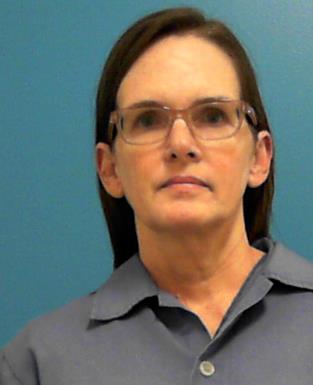
Denise Williams prison mugshot (Florida Department of Corrections)

Though the state’s Supreme Court declined to review the case, the appellate ruling underscored the legal nuance between planning a crime and physically carrying it out.

Epilogue

Denise raised Anslee Williams until her imprisonment. Anslee was then raised by Mike’s mother, Cheryl. Today, Anslee is a college graduate who lives and works in Tallahassee.

Today, Denise Williams remains incarcerated at the Florida Women’s Reception Center. Her scheduled release date is March 31, 2046.

You can read more about the Mike Williams murder in Evil at Lake Seminole by Steven B. Epstein and Guilty Creatures by Mikita Brottman.

Don’t Miss Out! Subscribe to the Newsletter

Subscribe to True Crime in the News, a monthly email newsletter that examines recent news stories of interest to true crime enthusiasts. The newsletter also summarizes the previous month’s blog posts. You won’t want to miss this. Join the newsletter mailing list today.

Reta Mays: Enormous Murder Scandal Found at V.A. Facility

Sadly, elder care facilities are often rife with mismanagement, incompetence, and indifference. Sometimes, though, there is actual malice afoot. Such was the case in 2017 and 2018. It was during this time that Reta Mays murdered seven residents of a West Virginia veteran’s care facility.

Reta Mays

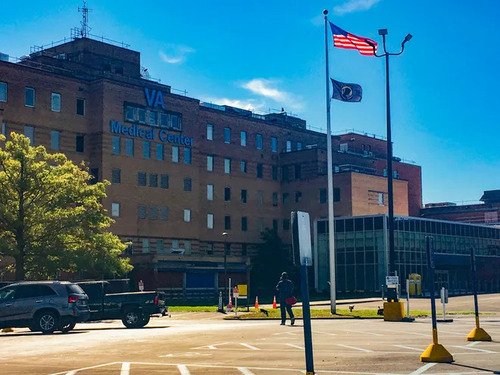
Reta Mays was a nursing assistant at the Louis A. Johnson Veterans Affairs Medical Center in Clarksburg, West Virginia. Between 2017 and 2018, she worked the overnight shift on Ward 3A. She later confessed to administering unauthorized doses of insulin to patients who did not have diabetes, causing the deaths of seven men. An eighth resident suffered severe health issues.

As a nursing assistant, Mays was not licensed to administer medication. Her job was to provide basic care, such as bathing, feeding, and transporting patients. However, she managed to obtain insulin and used it to dose non-diabetic patients. The victims were elderly male patients with varying medical conditions, none of which required treatment with insulin. Instead, the insulin caused hypoglycemia (an unexpected drop in blood sugar), seizures, loss of consciousness, and ultimately death.

Reta Mays (West Virginia Regional Jail)

The Johnson Medical Center was slow to investigate the rash of hypoglycemia cases. V.A. officials did not consider any of the deaths suspicious at the time. The patients, after all, were elderly and in relatively poor overall health.

A Pattern Emerges with Reta Mays

Over time, officials began to detect a pattern. Several patients who were otherwise stable died suddenly under similar circumstances. Concerns hardened into suspicion, which eventually led to a broader investigation. Autopsies of some of the deceased revealed inexplicably low blood sugar. They also detected traces of insulin, which should not have been present. The pattern pointed to nighttime incidents, and an examination of work schedules determined that all the suspicious cases occurred when Mays was on shift.

The Louis A. Johnson Veterans Affairs Medical Center in Clarksburg, West Virginia (Donovan Slack/USA Today)

The V.A. removed Mays from her position in 2018. In July 2020, she was charged with seven counts of second-degree murder and one count of assault with intent to commit murder. In court proceedings, Mays did not offer a clear explanation for the murders. She pleaded guilty to all eight counts. During sentencing, she expressed remorse and referenced mental health struggles without giving a concrete motive.

Reta Mays Receives Her Sentence

In May 2021, U.S. District Judge Thomas Kleeh sentenced Reta Mays to seven consecutive life sentences, one for each murder, plus an additional 20 years for the attempted murder. The sentencing took place in a federal courtroom in Clarksburg, where families of the victims provided victim impact statements detailing the pain and loss they had endured. Judge Kleeh described her crimes as cruel and senseless. He also emphasized the betrayal of the trust placed in her by the hospital, the victims, and their families. In addition to handing down the prison terms, Kleeh ordered Mays to pay restitution to the victims’ families.

Mays sobbed during her sentencing, suggesting her genuine remorse was for herself.

Reta Mays resides at the Federal Correctional Institution, Aliceville (Federal Bureau of Prisons)

All eight victims were military veterans who had served in various branches of the U.S. Armed Forces. Some of the victims’ remains were exhumed for autopsy as part of the investigation to confirm the presence of insulin.

  • Archie Edgell (U.S. Army, 1953–1955) died March 25, 2018.
  • Robert Edge Sr. (U.S. Navy, 1952–1956) died July 20, 2017.
  • Robert Kozul (U.S. Army 1951–1953) died January 29, 2018.
  • George Nelson Shaw Sr. (U.S. Air Force 1951–1982) died April 10, 2018.
  • William Holloway (U.S. Army 1942–1945) died April 4, 2018.
  • Felix McDermott (U.S. Army 1962–1968) died April 9, 2018.
  • Raymond Golden (U.S. Army 1951–1953, U.S. Air Force 1955–1973) died June 7, 2018.
  • Russell R. Posey Sr.(U.S. Navy1943–1946) survived insulin overdose June 18, 2018; died July 3, 2018.

Epilogue

Mays is currently serving her sentence at the Federal Correctional Facility, Aliceville in Pickens County, Alabama. She has no possibility of parole.

Don’t Miss Out! Subscribe to the Newsletter

Subscribe to True Crime in the News, a monthly email newsletter that examines recent news stories of interest to true crime enthusiasts. The newsletter also summarizes the previous month’s blog posts. You won’t want to miss this. Join the newsletter mailing list today.

Barrington: Daring Killer Guns Down Two FBI Agents

Today’s post features the Battle of Barrington. This 1934 shootout between gangster Baby Face Nelson and two FBI agents left the two agents dead, but also ended Nelson’s career of crime. It further heralded the twilight of the so-called “Public Enemies” era.

In the American Midwest in the early 1930s, while the country suffered from the worst of the Great Depression, several infamous criminal gangs rose to prominence. Newspaper headlines and cinema newsreels regularly featured names like John Dillinger, Pretty Boy Floyd, Machine Gun Kelly, and Lester Joseph Gillis (a.k.a. George “Baby Face” Nelson). Local police and even the nascent FBI seemed unable to put a stop to these so-called “Public Enemies.” As 1934 approached its end, the Division of Investigation (rechristened the Federal Bureau of Investigation on March 22, 1935) began to gain the upper hand. Their victories were not without cost, however.

The Battle of Barrington: Background

The man at the center of the Battle of Barrington was Lester Gillis, better known by the alias George “Baby Face” Nelson. Nelson was a career criminal who seemed to take a psychotic pleasure in killing. He gained infamy for participating in multiple bank robberies and violent clashes with law enforcement throughout the Midwest. He was an associate of John Dillinger and other criminal figures from the “Public Enemies” era. Nelson had eluded capture for several months following Dillinger’s death in July 1934. Now, at the end of November 1934, his luck ran out.

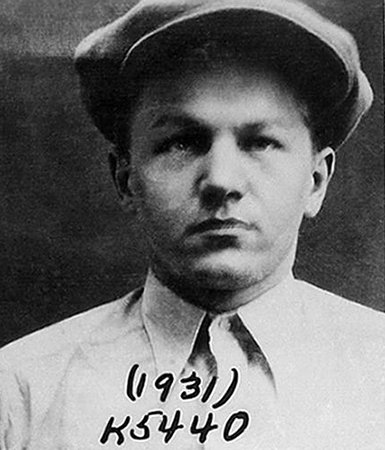
Baby Face Nelson mugshot
Baby Face Nelson in a 1931 mugshot

The climactic clash between Nelson and the FBI occurred near the Chicago suburb of Barrington, Illinois, on November 27, 1934. What began as a quiet, cold Tuesday ended with two FBI agents dead and the notorious gangster fatally wounded. The running gunfight marked one of the most significant and violent encounters in the Bureau’s early history.

The Battle of Barrington Unfolds

Events that led to the gunfight began earlier in the day, when federal agents received information suggesting Nelson might be in the area northwest of Chicago. Two agents, Inspector Samuel Cowley and Special Agent Herman “Ed” Hollis, were among those assigned to track and apprehend him. That afternoon, they spotted Nelson driving with his wife, Helen Gillis, and associate John Paul Chase near the town of Fox River Grove. Federal agents began pursuit, initiating a series of events that quickly escalated into a running gun battle.

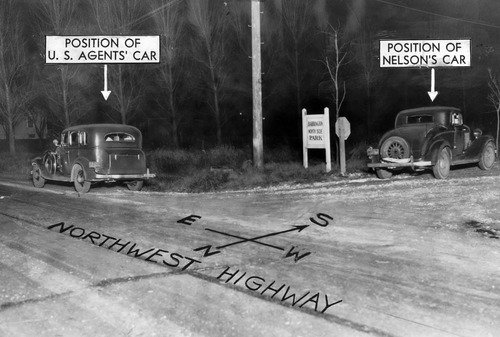
A recreation shows the positions of Nelson's and the federal agents' cars during the Battle of Barrington (Chicago Tribune)
A recreation shows the positions of Nelson’s and the federal agents’ cars during the Battle of Barrington (Chicago Tribune)

A brief car chase followed westward along U.S. Route 14 into Barrington. Heavily traveled today, at the time, it was a quiet rural road. Cowley and Hollis pursued Nelson in one car, while Agents Thomas McDade and William Ryan followed in another. The chase came to a halt near the entrance to North Side Park, a grassy expanse just outside of the downtown district. There, both parties stopped and exchanged gunfire again.

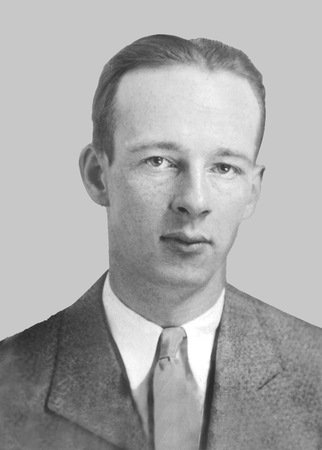
Special Agent Herman Edward "Ed" Hollis was mortally wounded during the Battle of Barrington (FBI)
Special Agent Herman Edward “Ed” Hollis was killed during the Battle of Barrington (FBI)

Nelson got out of his car with a .351 Winchester rifle, and Chase armed himself as well. Overmatched in firepower, Agents Hollis and Cowley nevertheless returned fire with their service weapons, ducking behind their vehicle. Witnesses later recalled the sounds of gunfire cracking through the otherwise still air, and the shouts of the combatants taking cover and issuing commands.

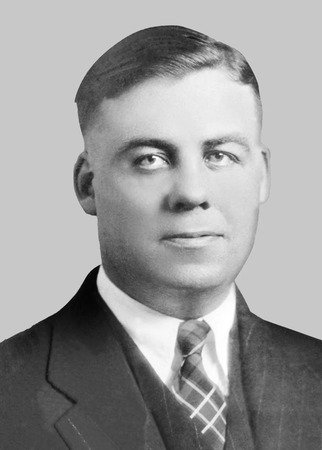
Inspector Samuel Parkinson Cowley was mortally wounded during the Battle of Barrington. He died at 2:00 a.m. the following day, but lived long enough to identify his attacker as Nelson. (FBI)

The Battle of Barrington Concludes

Nelson fought fiercely despite being outnumbered. He was hit multiple times early in the exchange but continued to attack. During the shootout, Agent Hollis was critically wounded. Cowley managed to maintain his position and continue firing until he, too, was mortally injured. Nelson, his severe wounds notwithstanding, approached the federal car and reportedly fired the fatal shots into Cowley before fleeing the scene with Chase and his wife.

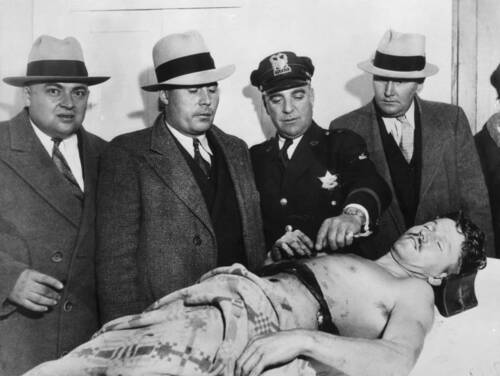
Baby Face Nelson lies on the undertaker's slab in the Niles Center morgue (Chicago Tribune)
Baby Face Nelson lies dead on the undertaker’s slab in the Niles Center morgue (Chicago Tribune)

Chase helped Nelson back into their bullet-riddled car, and the three drove away, leaving behind the two stricken agents and a crime scene littered with spent cartridges. Witnesses provided conflicting accounts of the sequence of events, but the battle, which lasted several minutes, left an indelible mark on the local community.

Nelson died from his wounds later that night. His body was found wrapped in a blanket and left near a cemetery in the Chicago suburb of Niles Center (now Skokie). Helen Gillis later surrendered to authorities. Chase managed to evade capture for some time but was ultimately caught and arrested.

Aftermath of the Battle of Barrington

The deaths of Agents Cowley and Hollis shocked the Bureau. Both men were regarded as experienced and committed law enforcement officers. Their loss highlighted the dangers federal agents faced during an especially violent era in American criminal history. The Bureau began placing new emphasis on training, investigative rigor, and armed response. But the Battle of Barrington served as a reminder of the risks involved in confronting heavily armed fugitives.

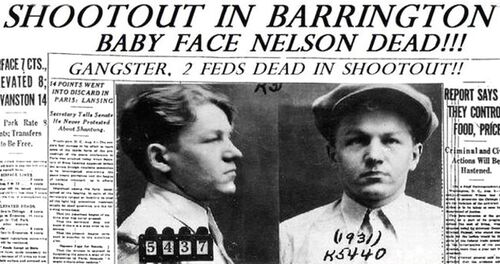
The Chicago Tribune announces Nelson's death after the Battle of Barrington (Chicago Tribune)
The Chicago Tribune announces Nelson’s death after the Battle of Barrington (Chicago Tribune)

At the time, Barrington was a modest village of just over 2,000 people, unaccustomed to such violence. Residents gathered near the site in the hours and days following, observing the bullet holes in road signs and fences. Newspapers across the country picked up the story as well, further cementing the battle in the public’s mind.

Epilogue

Barrington marked the end of Nelson’s criminal career and was a turning point in the campaign against the era’s most notorious outlaws. Within a year, the so-called “Public Enemies” period would largely come to a close, as most high-profile figures were captured or killed.  Concurrently, the FBI’s authority continued to expand.

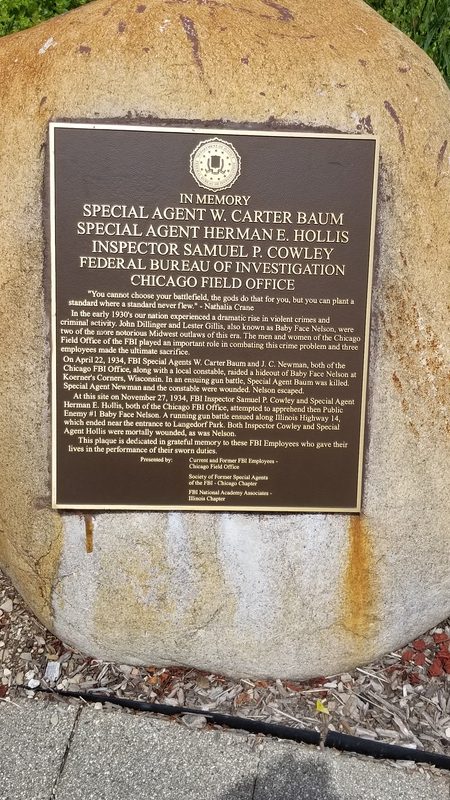
Nearly a century has passed since the Battle of Barrington, but it remains a notable chapter in the story of American law enforcement. A small plaque today marks the site of the shootout, honoring the memory of the two agents who lost their lives in the line of duty.

Plaque commemorating the Battle of Barrington (Author's photo)
Plaque commemorating the Battle of Barrington (Author’s photo)

Many authors have written about the events and players of the “Public Enemies” era. The absolute best, in my opinion, is Bryan Burrough’s Public Enemies: America’s Greatest Crime Wave and the Birth of the FBI, 1933-34. You can also check out Baby Face Nelson: Portrait of a Public Enemy by Steven Nickel. Another good read is John Toland’s The Dillinger Days. It is an older book, but it was one of the best early histories of Depression-era outlaws.

Don’t Miss Out! Subscribe to the Newsletter

Subscribe to True Crime in the News, a monthly email newsletter that examines recent news stories of interest to true crime enthusiasts. The newsletter also summarizes the previous month’s blog posts. You won’t want to miss this. Join the newsletter mailing list today.