
The blog is back after a two-month hiatus. I am a one-man show, and it can be challenging to produce a new blog every week. With the climax of baseball season and some other personal disruptions, I have not blogged for a couple of months. However, this week, I return with a presentation about Dr. Thomas Neill Cream. Neill Cream was a Victorian doctor, a convicted poisoner, and a man who some suspected was Jack the Ripper. Read his story below.
The Life and Crimes of Dr. Thomas Neill Cream
Neill Cream was one of the most infamous poisoners of the Victorian era. A trained physician, his medical knowledge became a weapon in a series of murders that spanned multiple continents. He died on the gallows in London in 1892, but his criminal legacy continues to fascinate criminologists and historians alike.

Thomas Neill Cream was born in Glasgow, Scotland, in 1850, the eldest son of a prosperous shipbuilder. His family emigrated to Canada during his youth, settling in Quebec, where Cream grew up in relatively comfortable circumstances. In his early years, he demonstrated academic promise and eventually enrolled at McGill University in Montreal to study medicine.
While at McGill, Cream developed a fascination with chemistry and toxicology, disciplines that would later be a core component of his crimes. He graduated as a physician in 1876 after completing a thesis on chloroform. Shortly afterward, he moved to London for advanced training at St. Thomas’s Hospital before practicing medicine in North America.
Early Criminal Activity
Cream’s professional career quickly became intertwined with scandal. While practicing in Canada and later in the United States, he developed a reputation for performing illegal abortions, often under dangerous circumstances. One of his earliest brushes with the law came in 1879 when a young woman named Kate Gardener died after taking a medicine Craem prescribed. Though suspicion fell upon him, no charges were sustained.

Relocating to Chicago, Cream continued his medical practice but became embroiled in a more serious case. In 1881, the body of Daniel Stott, one of Cream’s patients, was discovered with traces of strychnine poisoning. Investigations revealed that Cream had supplied the fatal substance and had also been engaged in an affair with Stott’s wife. He was arrested, tried, and convicted of murder. Sentenced to life imprisonment, Cream was sent to Joliet Prison in Illinois.
Neill Cream Released
Despite the murder conviction, Cream did not serve out his life sentence. In 1891, after only ten years, he was released, reportedly through the intervention of influential family connections and perhaps bribery. Having regained his freedom, Cream left America and returned to London, settling in the Lambeth district.
London in the 1890s provided fertile ground for a man of Cream’s ambitions. The bustling city was crowded, with areas of extreme poverty and vice coexisting alongside wealth and privilege. Lambeth, in particular, was known for its red-light district, and it was here that Cream found many of his victims.
Neill Cream Resumes Poisoning in London
Soon after his arrival, young women in Lambeth began to die under mysterious circumstances. Cream consistently used strychnine, a lethal poison that was readily available at the time. The victims were often sex workers, women with little protection or recourse, making them vulnerable targets.
Among his victims were women such as Matilda Clover, who died in 1891. Initially, her death was recorded as natural, but Cream later incriminated himself by writing anonymous letters to authorities and acquaintances, claiming another physician had poisoned Clover. This peculiar tendency to boast and manipulate would ultimately contribute to his downfall.
Cream’s campaign of poisoning continued through 1891 and 1892, with other victims including Alice Marsh and Emma Shrivell. Each woman suffered an agonizing death from strychnine, and in each case, Cream attempted to deflect suspicion or even extort money by accusing others of the crimes. His pattern of sending letters and inserting himself into investigations raised suspicions about his character.
Investigation and Neill Cream Arrested
By mid-1892, authorities were piecing together evidence linking Cream to the series of poisonings. His peculiar behavior in writing letters that named himself as a witness or suggested knowledge of the murders raised questions. Detectives watched his movements closely, noting his associations with the victims and his habit of discussing poison with acquaintances.

Ultimately, police determined that Cream had purchased strychnine shortly before several of the murders, providing material evidence against him. Witness testimony further tied him to the victims, and the case against him solidified. He was arrested in June 1892 and charged with multiple counts of murder.
Neill Cream On Trial at the Old Bailey
Cream’s trial for the murder of Matilda Clover opened at the Central Criminal Court—the Old Bailey—in October 1892. The proceedings drew enormous public attention, as the case combined sensational elements of medicine, poison, sexual scandal, and serial murder.
The prosecution presented evidence of Cream’s purchase of strychnine and his proximity to the victims before their deaths. Testimony from chemists confirmed that he had obtained the poison, while witnesses described his suspicious conversations and behavior. Particularly damning were his incriminating letters, which revealed both his knowledge of the crimes and his attempt to implicate others.
The defense attempted to argue that the evidence was circumstantial, but the cumulative weight of the case proved overwhelming. The jury deliberated only twelve minutes before finding him guilty on all counts.
Neill Cream Sentenced and Executed
Following the guilty verdict, Cream was sentenced to death by hanging. His execution was set for November 15, 1892, at Newgate Prison in London. On the morning of the hanging, crowds gathered outside the prison, as was common in high-profile cases of the era, eager to witness the outcome of one of Britain’s most notorious trials.
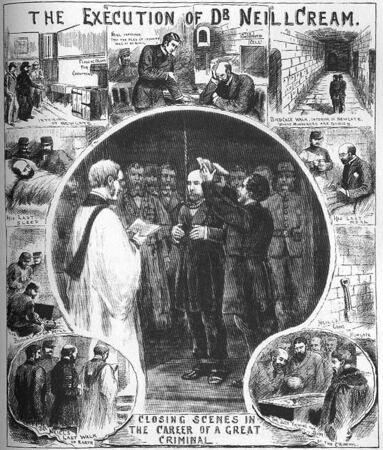
At the gallows, Cream reportedly attempted to speak, though accounts differ on his final words. According to some reports, he began to declare “I am Jack—,” leading to speculation that he intended to claim responsibility for the crimes of Jack the Ripper. The hangman quickly pulled the lever, cutting short any further statement. Whether this was a genuine confession, a last-minute attempt at notoriety, or a misheard phrase remains debated.
Epilogue
Neill Cream’s poisonings ended with his death, but his execution did not squelch the rumors that he was Jack the Ripper. Although hangman James Billington reported Cream’s last words to be “I am Jack…,” other witnesses to the execution did not report such an event. Furthermore, Cream was incarcerated in Illinois during the Ripper’s 1888 murder spree. Theories that Cream bribed his way out of prison before his official release or that a look-alike served his sentence lack any supporting evidence.
You can read more about Neill Cream and his crimes in A Prescription for Murder, a 1995 book by Angus McLaren, and The Case of the Murderous Dr. Cream by Dean Jobb. W. Teignmouth Shore’s Trial of Thomas Neil Cream presents a detailed account of Cream’s trial.
Don’t Miss Out! Subscribe to the Newsletter
Subscribe to True Crime in the News, a monthly email newsletter that examines recent news stories of interest to true crime enthusiasts. The newsletter also summarizes the blog posts from the previous month. You won’t want to miss this. Join the newsletter mailing list today.